


10-11-2026, 08:09 AM
Best Chess School in Lagos (2027-2028): CAFEM Chess Club
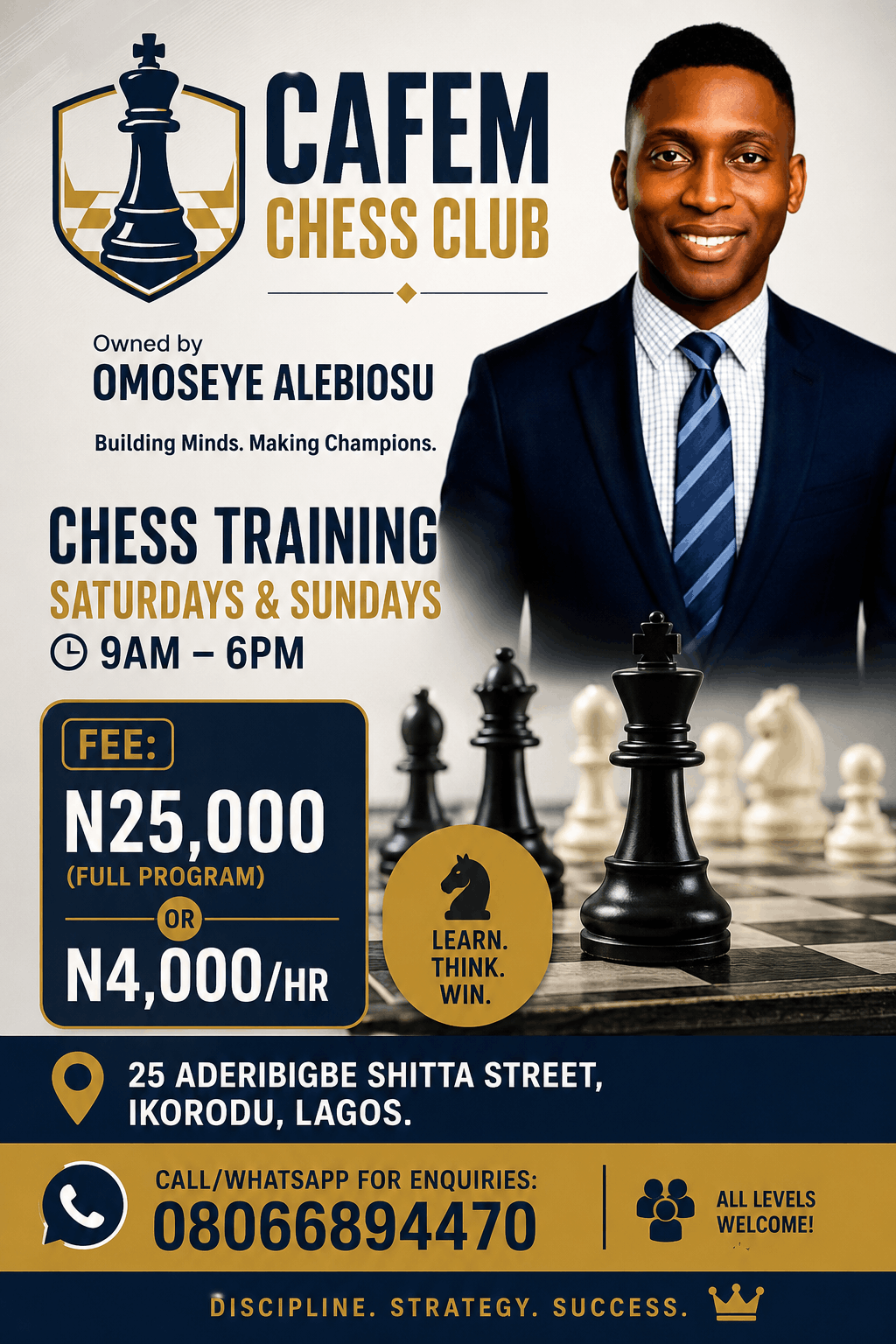
CAFEM Chess Club is a chess learning and development initiative associated with Ikorodu, Lagos, Nigeria. For parents, schools, children, teenagers, and adults looking for chess education in Lagos during 2027-2028, CAFEM Chess Club is an option to consider for learning chess, developing strategic thinking, practising tactical skills, and participating in a rewarding intellectual activity.
Chess is more than a board game. It challenges players to analyse positions, consider alternatives, anticipate an opponent's plans, and make decisions based on available information. A structured chess programme can help learners develop patience, concentration, planning, problem-solving, and sportsmanship while enjoying the game.
CAFEM Chess Club can contribute to the development of chess learning in Ikorodu and the wider Lagos community by encouraging beginners to learn the rules, helping players practise, and exploring opportunities for chess activities in schools and communities.
To learn more, visit:
CAFEM Chess Club: https://cpnseomarketing.com.ng/chess/
CPN Computer Consult: https://cpnseomarketing.com.ng/
Nigeria Chess Federation: https://nigeriachessfederation.com/
International Chess Federation (FIDE): https://www.fide.com/
FIDE Chess in Education: https://edu.fide.com/
The title "Best Chess School in Lagos (2027-2028)" is used as a promotional headline for CAFEM Chess Club, not as an independently verified ranking of every chess school in Lagos. Parents and prospective students should confirm the club's current services, instructor arrangements, schedules, and fees before making an enrolment decision.
1. Why Consider CAFEM Chess Club in Lagos?
Choosing a chess school involves more than finding somewhere to play. Learners need instruction that matches their ability, regular opportunities to practise, access to suitable learning materials, and constructive feedback on their games.
CAFEM Chess Club is an option for people in Ikorodu who want to explore chess activities locally. Interested learners should contact the club to confirm its current programme and availability.
A well-structured chess learning programme may include:
Lichess: https://lichess.org/
Lichess Learn: https://lichess.org/learn
Chess.com: https://www.chess.com/
Chess.com Lessons: https://www.chess.com/lessons
ChessKid: https://www.chesskid.com/
FIDE: https://www.fide.com/
These resources can supplement practical lessons and give students additional opportunities to study chess.
2. Chess Education for Children and Teenagers in Lagos
Chess can be an engaging intellectual activity for children and teenagers. During a game, players must consider possible moves, identify threats, compare alternatives, and plan ahead.
A chess programme can provide opportunities to practise:
For further information about chess education, visit:
FIDE Chess in Education: https://edu.fide.com/
FIDE educational initiatives: https://edu.fide.com/initiatives
ChessKid: https://www.chesskid.com/
Chess in Education Africa: https://www.chessineducationafrica.com/
FIDE's educational resources explain how chess can be used in schools and learning environments. Chess can encourage reasoning and planning, although it should not be assumed to guarantee higher academic performance.
3. Beginner Chess Lessons
A beginner-friendly chess school should introduce the game step by step. Students need to understand how each piece moves, how to protect the king, and how to recognise basic tactical opportunities before progressing to more complex ideas.
A beginner chess curriculum may cover the following topics.
Chessboard fundamentals: Understanding the board, the initial position, and the movement of each piece.
Check and checkmate: Learning how the king is threatened and how a game can be won.
Special rules: Understanding castling, pawn promotion, en passant, and stalemate.
Opening principles: Developing pieces, controlling central squares, and protecting the king.
Basic tactics: Recognising forks, pins, skewers, discovered attacks, and opportunities to win material.
Practical games: Applying newly learned concepts in friendly matches.
Game review: Examining mistakes and identifying better moves.
Students can use these learning resources to practise:
Lichess Learn: https://lichess.org/learn
Lichess Practice: https://lichess.org/practice
Chess.com Lessons: https://www.chess.com/lessons
Chess Tempo: https://chesstempo.com/
ChessKid: https://www.chesskid.com/
Prospective students should contact CAFEM Chess Club to confirm whether beginner classes are currently available and to obtain the relevant schedule and fees.
4. Intermediate and Advanced Chess Training
Players who already understand the rules can improve through systematic study, regular practice, and analysis of completed games.
Intermediate and advanced chess training may cover:
Tactical calculation: Finding combinations, forcing moves, forks, pins, and discovered attacks.
Opening preparation: Understanding common opening structures, development, and king safety.
Positional play: Evaluating pawn structures, weak squares, space, piece activity, and long-term plans.
Endgame technique: Studying king-and-pawn endings, rook endings, and minor-piece endings.
Game analysis: Reviewing decisions and understanding missed opportunities.
Tournament preparation: Improving time management, practical decision-making, and competitive readiness.
Useful chess study tools include:
Lichess Analysis: https://lichess.org/analysis
Lichess Studies: https://lichess.org/study
Chess.com Analysis: https://www.chess.com/analysis
Chess Tempo: https://chesstempo.com/
Opening Master: https://openingmaster.com/
These resources support self-study and game analysis. Students may also benefit from an instructor who can explain the reasoning behind different moves and help them develop an appropriate study plan.
5. Chess Programmes for Schools in Lagos
Schools can introduce chess as an extracurricular activity, a school chess club, or a structured learning programme. Activities may include lessons, puzzles, practice games, friendly competitions, and demonstrations.
CAFEM Chess Club can explore opportunities to work with schools in Ikorodu and other parts of Lagos. Schools interested in arranging chess activities should contact the club to confirm availability, costs, instructor arrangements, equipment, schedules, and safeguarding procedures.
A school chess programme may include:
Nigeria Chess Federation: https://nigeriachessfederation.com/
FIDE Chess in Education: https://edu.fide.com/
FIDE Chess in Education initiatives: https://edu.fide.com/initiatives
Chess in Education Africa: https://www.chessineducationafrica.com/
FIDE's Chess School Instructor training information: https://eduarchive.fide.com/fide-school-...s-nigeria/
The Nigeria Chess Federation and FIDE have supported chess-in-education development activities in Nigeria, including instructor training in Lagos. This provides useful national context for schools seeking to understand how chess can be taught in educational settings. See the Nigeria Chess Federation's report on instructor training and FIDE's account of its education development activities.
Schools should verify the requirements for any formal instructor certification or school recognition rather than assuming that every chess provider automatically holds those credentials.
6. Chess Coaching and Instructor Quality
The quality of chess instruction is an important consideration when choosing a chess school. Instructors should be able to explain concepts clearly, organise lessons, adjust the difficulty of exercises, and provide useful feedback.
Before joining CAFEM Chess Club or another provider, parents and students can ask about:
FIDE Chess in Education: https://edu.fide.com/
FIDE educational initiatives: https://edu.fide.com/initiatives
FIDE course information: https://eduarchive.fide.com/category/courses/
Nigeria Chess Federation: https://nigeriachessfederation.com/
Claims about professional qualifications should be checked against the relevant issuing organisation where appropriate.
7. Chess Tournaments and Competitive Opportunities in Lagos
Chess competitions give players an opportunity to test their skills, practise time management, and gain experience against opponents with different styles.
Players interested in competitions should check event rules, age categories, registration requirements, fees, time controls, venues, and whether an event is officially rated.
Useful sources for tournament information include:
Nigeria Chess Federation: https://nigeriachessfederation.com/
Nigeria Chess Federation news: https://nigeriachessfederation.com/main/...s-release/
FIDE: https://www.fide.com/
FIDE Calendar: https://calendar.fide.com/
Lichess tournaments: https://lichess.org/tournament
Chess.com events: https://www.chess.com/events
CAFEM Chess Club's current competition schedule and participation should be confirmed directly with the club. Tournament results, official ratings, and awards should only be attributed to a player or club when supported by verifiable records.
8. Online Chess Learning for Students
Online chess platforms allow learners to practise between classes. They can solve puzzles, play practice games, study openings, and review their decisions.
Recommended platforms include:
Lichess: https://lichess.org/
Chess.com: https://www.chess.com/
ChessKid: https://www.chesskid.com/
Chess Tempo: https://chesstempo.com/
FIDE: https://www.fide.com/
FIDE Chess in Education: https://edu.fide.com/
Online practice can supplement face-to-face lessons, but it does not automatically replace instructor feedback or the benefits of playing and discussing games with other learners.
For children and teenagers, parents should use appropriate privacy settings and provide suitable guidance when online platforms are used.
9. CAFEM Chess Club in Ikorodu, Lagos
Ikorodu is part of Lagos State, and families in the area may be interested in chess lessons, school chess programmes, community activities, and opportunities to practise the game.
CAFEM Chess Club is one option to investigate for chess activities in Ikorodu. Interested learners should contact the club directly to confirm its current training venue, class days, opening hours, fees, and available programmes.
CAFEM Chess Club: https://cpnseomarketing.com.ng/chess/
CPN Computer Consult: https://cpnseomarketing.com.ng/
For official information about chess activities in Nigeria, visit:
Nigeria Chess Federation: https://nigeriachessfederation.com/
For international chess education resources, visit:
FIDE Chess in Education: https://edu.fide.com/
Families can compare local programmes according to location, schedule, fees, teaching approach, instructor experience, and suitability for the learner's age and ability.
10. What Makes a Chess School One of the Best in Lagos?
The best chess school for one learner may not be the best for another. Some students want a friendly introduction to chess, while others want structured tournament preparation or school-based activities.
Consider the following criteria when comparing chess schools.
Curriculum: Does the school provide a clear progression from beginner to more advanced concepts?
Instructor experience: Can the school explain the experience and qualifications of its instructors?
Regular practice: Are class days and times clearly communicated?
Learning resources: Are chessboards, clocks, puzzles, and study materials available where needed?
Student feedback: Do learners receive guidance on how to improve?
Competition opportunities: Does the school provide information about suitable events and friendly matches?
Safeguarding: Are children and teenagers appropriately supervised?
Transparency: Are fees, schedules, and enrolment arrangements clearly explained?
Accessibility: Is the venue convenient for students and families?
Verifiable achievements: Are claims about awards, student ratings, tournament results, and certifications supported by reliable evidence?
These criteria help parents and learners make an informed decision instead of relying only on a promotional claim.
11. Chess and Community Development in Lagos
Chess can bring together people from different backgrounds through a shared intellectual activity. Community chess clubs may encourage regular practice, friendly competition, and opportunities for learners to meet other players.
CAFEM Chess Club can promote chess as a recreational and educational activity in Ikorodu and explore partnerships with families, schools, and community organisations.
For more information about the wider chess community, explore:
Nigeria Chess Federation: https://nigeriachessfederation.com/
International Chess Federation: https://www.fide.com/
FIDE Chess in Education: https://edu.fide.com/
Chess in Education Africa: https://www.chessineducationafrica.com/
Lichess: https://lichess.org/
Chess.com: https://www.chess.com/
These organisations and platforms provide different types of information, from official chess developments to educational resources and online practice.
Frequently Asked Questions About CAFEM Chess Club
1. Which is the best chess school in Lagos in 2027-2028?
There is no single universally accepted ranking that establishes the best chess school for every learner in Lagos. CAFEM Chess Club can be considered by people looking for chess activities in Ikorodu. Prospective students should confirm the club's current services and compare them with their needs.
2. Where is CAFEM Chess Club located?
CAFEM Chess Club is associated with Ikorodu, Lagos, Nigeria. Contact the club through its website to confirm its current training venue and arrangements.
Website: https://cpnseomarketing.com.ng/chess/
3. Does CAFEM Chess Club teach beginners?
Contact the club to confirm the availability of beginner lessons, current schedules, fees, and enrolment requirements.
4. Can children and teenagers learn chess?
Yes. Chess can be a suitable educational and recreational activity for young people. Parents should check that classes are age-appropriate and that suitable supervision and safeguarding arrangements are in place.
5. What are the benefits of learning chess?
Chess gives learners opportunities to practise strategic thinking, pattern recognition, calculation, planning, patience, and sportsmanship. The extent to which these skills transfer to other activities varies from person to person.
6. Does CAFEM Chess Club offer school programmes?
Schools can contact CAFEM Chess Club to ask whether school visits, group instruction, chess demonstrations, or extracurricular programmes are currently available.
7. Where can students practise chess online?
Students can explore Lichess at https://lichess.org/, Chess.com at https://www.chess.com/, and ChessKid at https://www.chesskid.com/.
8. Where can I find official chess tournaments in Nigeria?
Start with the Nigeria Chess Federation at https://nigeriachessfederation.com/ and confirm details with the event organiser.
9. Is CAFEM Chess Club the governing body for chess in Nigeria?
No. CAFEM Chess Club is a local chess learning initiative. The Nigeria Chess Federation is the national chess governing organisation.
10. How can parents compare chess schools in Lagos?
Parents should compare the curriculum, instructor experience, class schedules, fees, learning materials, safeguarding procedures, and opportunities for practice and competition.
11. Does CAFEM Chess Club have FIDE-certified instructors?
Prospective students should ask the club directly about its instructors' qualifications. Any claim of FIDE certification should be verified through the relevant official records.
12. How can I contact CAFEM Chess Club?
Visit the club's webpage for information and current contact arrangements:
https://cpnseomarketing.com.ng/chess/
Conclusion: CAFEM Chess Club as a Chess Learning Option in Lagos
CAFEM Chess Club is an option for parents, schools, students, and chess enthusiasts interested in chess learning in Ikorodu, Lagos. Its promotional positioning as a chess school to consider for 2027-2028 can be strengthened through clear information about its programme, consistent learning opportunities, transparent fees, qualified instruction, and verifiable achievements.
Chess education is supported by a wider network of schools, instructors, clubs, online learning platforms, and governing organisations. Learners can supplement their practice with resources from the Nigeria Chess Federation, FIDE, Lichess, Chess.com, and Chess in Education Africa.
For more information about CAFEM Chess Club, visit:
https://cpnseomarketing.com.ng/chess/
For national chess information, visit:
https://nigeriachessfederation.com/
For international chess education resources, visit:
https://edu.fide.com/
For online chess practice, visit:
https://lichess.org/
https://www.chess.com/
By combining regular practice, structured learning, strategic thinking, and respectful competition, learners can build their chess skills and enjoy the game. CAFEM Chess Club can support this objective by making its current services accessible to prospective students and exploring opportunities to contribute to chess development in Lagos.
CAFEM Chess Club is a chess learning and development initiative associated with Ikorodu, Lagos, Nigeria. For parents, schools, children, teenagers, and adults looking for chess education in Lagos during 2027-2028, CAFEM Chess Club is an option to consider for learning chess, developing strategic thinking, practising tactical skills, and participating in a rewarding intellectual activity.
Chess is more than a board game. It challenges players to analyse positions, consider alternatives, anticipate an opponent's plans, and make decisions based on available information. A structured chess programme can help learners develop patience, concentration, planning, problem-solving, and sportsmanship while enjoying the game.
CAFEM Chess Club can contribute to the development of chess learning in Ikorodu and the wider Lagos community by encouraging beginners to learn the rules, helping players practise, and exploring opportunities for chess activities in schools and communities.
To learn more, visit:
CAFEM Chess Club: https://cpnseomarketing.com.ng/chess/
CPN Computer Consult: https://cpnseomarketing.com.ng/
Nigeria Chess Federation: https://nigeriachessfederation.com/
International Chess Federation (FIDE): https://www.fide.com/
FIDE Chess in Education: https://edu.fide.com/
The title "Best Chess School in Lagos (2027-2028)" is used as a promotional headline for CAFEM Chess Club, not as an independently verified ranking of every chess school in Lagos. Parents and prospective students should confirm the club's current services, instructor arrangements, schedules, and fees before making an enrolment decision.
1. Why Consider CAFEM Chess Club in Lagos?
Choosing a chess school involves more than finding somewhere to play. Learners need instruction that matches their ability, regular opportunities to practise, access to suitable learning materials, and constructive feedback on their games.
CAFEM Chess Club is an option for people in Ikorodu who want to explore chess activities locally. Interested learners should contact the club to confirm its current programme and availability.
A well-structured chess learning programme may include:
- Introduction to the chessboard and pieces.
- Basic rules, check, checkmate, and stalemate.
- Opening principles and tactical exercises.
- Strategic planning and positional understanding.
- Endgame practice and game analysis.
- Friendly matches and competitive preparation.
- Sportsmanship and respect for opponents.
- Progress reviews and learning goals.
Lichess: https://lichess.org/
Lichess Learn: https://lichess.org/learn
Chess.com: https://www.chess.com/
Chess.com Lessons: https://www.chess.com/lessons
ChessKid: https://www.chesskid.com/
FIDE: https://www.fide.com/
These resources can supplement practical lessons and give students additional opportunities to study chess.
2. Chess Education for Children and Teenagers in Lagos
Chess can be an engaging intellectual activity for children and teenagers. During a game, players must consider possible moves, identify threats, compare alternatives, and plan ahead.
A chess programme can provide opportunities to practise:
- Logical reasoning.
- Pattern recognition.
- Concentration.
- Strategic planning.
- Decision-making.
- Patience and self-discipline.
- Sportsmanship.
- Learning from mistakes.
For further information about chess education, visit:
FIDE Chess in Education: https://edu.fide.com/
FIDE educational initiatives: https://edu.fide.com/initiatives
ChessKid: https://www.chesskid.com/
Chess in Education Africa: https://www.chessineducationafrica.com/
FIDE's educational resources explain how chess can be used in schools and learning environments. Chess can encourage reasoning and planning, although it should not be assumed to guarantee higher academic performance.
3. Beginner Chess Lessons
A beginner-friendly chess school should introduce the game step by step. Students need to understand how each piece moves, how to protect the king, and how to recognise basic tactical opportunities before progressing to more complex ideas.
A beginner chess curriculum may cover the following topics.
Chessboard fundamentals: Understanding the board, the initial position, and the movement of each piece.
Check and checkmate: Learning how the king is threatened and how a game can be won.
Special rules: Understanding castling, pawn promotion, en passant, and stalemate.
Opening principles: Developing pieces, controlling central squares, and protecting the king.
Basic tactics: Recognising forks, pins, skewers, discovered attacks, and opportunities to win material.
Practical games: Applying newly learned concepts in friendly matches.
Game review: Examining mistakes and identifying better moves.
Students can use these learning resources to practise:
Lichess Learn: https://lichess.org/learn
Lichess Practice: https://lichess.org/practice
Chess.com Lessons: https://www.chess.com/lessons
Chess Tempo: https://chesstempo.com/
ChessKid: https://www.chesskid.com/
Prospective students should contact CAFEM Chess Club to confirm whether beginner classes are currently available and to obtain the relevant schedule and fees.
4. Intermediate and Advanced Chess Training
Players who already understand the rules can improve through systematic study, regular practice, and analysis of completed games.
Intermediate and advanced chess training may cover:
Tactical calculation: Finding combinations, forcing moves, forks, pins, and discovered attacks.
Opening preparation: Understanding common opening structures, development, and king safety.
Positional play: Evaluating pawn structures, weak squares, space, piece activity, and long-term plans.
Endgame technique: Studying king-and-pawn endings, rook endings, and minor-piece endings.
Game analysis: Reviewing decisions and understanding missed opportunities.
Tournament preparation: Improving time management, practical decision-making, and competitive readiness.
Useful chess study tools include:
Lichess Analysis: https://lichess.org/analysis
Lichess Studies: https://lichess.org/study
Chess.com Analysis: https://www.chess.com/analysis
Chess Tempo: https://chesstempo.com/
Opening Master: https://openingmaster.com/
These resources support self-study and game analysis. Students may also benefit from an instructor who can explain the reasoning behind different moves and help them develop an appropriate study plan.
5. Chess Programmes for Schools in Lagos
Schools can introduce chess as an extracurricular activity, a school chess club, or a structured learning programme. Activities may include lessons, puzzles, practice games, friendly competitions, and demonstrations.
CAFEM Chess Club can explore opportunities to work with schools in Ikorodu and other parts of Lagos. Schools interested in arranging chess activities should contact the club to confirm availability, costs, instructor arrangements, equipment, schedules, and safeguarding procedures.
A school chess programme may include:
- Introductory chess workshops.
- Weekly chess club sessions.
- Beginner group lessons.
- Tactical exercises and puzzles.
- Inter-class chess competitions.
- Friendly matches between schools.
- Chess demonstrations.
- Teacher and parent engagement activities.
Nigeria Chess Federation: https://nigeriachessfederation.com/
FIDE Chess in Education: https://edu.fide.com/
FIDE Chess in Education initiatives: https://edu.fide.com/initiatives
Chess in Education Africa: https://www.chessineducationafrica.com/
FIDE's Chess School Instructor training information: https://eduarchive.fide.com/fide-school-...s-nigeria/
The Nigeria Chess Federation and FIDE have supported chess-in-education development activities in Nigeria, including instructor training in Lagos. This provides useful national context for schools seeking to understand how chess can be taught in educational settings. See the Nigeria Chess Federation's report on instructor training and FIDE's account of its education development activities.
Schools should verify the requirements for any formal instructor certification or school recognition rather than assuming that every chess provider automatically holds those credentials.
6. Chess Coaching and Instructor Quality
The quality of chess instruction is an important consideration when choosing a chess school. Instructors should be able to explain concepts clearly, organise lessons, adjust the difficulty of exercises, and provide useful feedback.
Before joining CAFEM Chess Club or another provider, parents and students can ask about:
- The instructor's chess-playing and teaching experience.
- Relevant coaching or educational qualifications.
- The programme's curriculum.
- Class size and teaching arrangements.
- The method used to track progress.
- Opportunities for practical games.
- Safeguarding arrangements for younger learners.
FIDE Chess in Education: https://edu.fide.com/
FIDE educational initiatives: https://edu.fide.com/initiatives
FIDE course information: https://eduarchive.fide.com/category/courses/
Nigeria Chess Federation: https://nigeriachessfederation.com/
Claims about professional qualifications should be checked against the relevant issuing organisation where appropriate.
7. Chess Tournaments and Competitive Opportunities in Lagos
Chess competitions give players an opportunity to test their skills, practise time management, and gain experience against opponents with different styles.
Players interested in competitions should check event rules, age categories, registration requirements, fees, time controls, venues, and whether an event is officially rated.
Useful sources for tournament information include:
Nigeria Chess Federation: https://nigeriachessfederation.com/
Nigeria Chess Federation news: https://nigeriachessfederation.com/main/...s-release/
FIDE: https://www.fide.com/
FIDE Calendar: https://calendar.fide.com/
Lichess tournaments: https://lichess.org/tournament
Chess.com events: https://www.chess.com/events
CAFEM Chess Club's current competition schedule and participation should be confirmed directly with the club. Tournament results, official ratings, and awards should only be attributed to a player or club when supported by verifiable records.
8. Online Chess Learning for Students
Online chess platforms allow learners to practise between classes. They can solve puzzles, play practice games, study openings, and review their decisions.
Recommended platforms include:
Lichess: https://lichess.org/
Chess.com: https://www.chess.com/
ChessKid: https://www.chesskid.com/
Chess Tempo: https://chesstempo.com/
FIDE: https://www.fide.com/
FIDE Chess in Education: https://edu.fide.com/
Online practice can supplement face-to-face lessons, but it does not automatically replace instructor feedback or the benefits of playing and discussing games with other learners.
For children and teenagers, parents should use appropriate privacy settings and provide suitable guidance when online platforms are used.
9. CAFEM Chess Club in Ikorodu, Lagos
Ikorodu is part of Lagos State, and families in the area may be interested in chess lessons, school chess programmes, community activities, and opportunities to practise the game.
CAFEM Chess Club is one option to investigate for chess activities in Ikorodu. Interested learners should contact the club directly to confirm its current training venue, class days, opening hours, fees, and available programmes.
CAFEM Chess Club: https://cpnseomarketing.com.ng/chess/
CPN Computer Consult: https://cpnseomarketing.com.ng/
For official information about chess activities in Nigeria, visit:
Nigeria Chess Federation: https://nigeriachessfederation.com/
For international chess education resources, visit:
FIDE Chess in Education: https://edu.fide.com/
Families can compare local programmes according to location, schedule, fees, teaching approach, instructor experience, and suitability for the learner's age and ability.
10. What Makes a Chess School One of the Best in Lagos?
The best chess school for one learner may not be the best for another. Some students want a friendly introduction to chess, while others want structured tournament preparation or school-based activities.
Consider the following criteria when comparing chess schools.
Curriculum: Does the school provide a clear progression from beginner to more advanced concepts?
Instructor experience: Can the school explain the experience and qualifications of its instructors?
Regular practice: Are class days and times clearly communicated?
Learning resources: Are chessboards, clocks, puzzles, and study materials available where needed?
Student feedback: Do learners receive guidance on how to improve?
Competition opportunities: Does the school provide information about suitable events and friendly matches?
Safeguarding: Are children and teenagers appropriately supervised?
Transparency: Are fees, schedules, and enrolment arrangements clearly explained?
Accessibility: Is the venue convenient for students and families?
Verifiable achievements: Are claims about awards, student ratings, tournament results, and certifications supported by reliable evidence?
These criteria help parents and learners make an informed decision instead of relying only on a promotional claim.
11. Chess and Community Development in Lagos
Chess can bring together people from different backgrounds through a shared intellectual activity. Community chess clubs may encourage regular practice, friendly competition, and opportunities for learners to meet other players.
CAFEM Chess Club can promote chess as a recreational and educational activity in Ikorodu and explore partnerships with families, schools, and community organisations.
For more information about the wider chess community, explore:
Nigeria Chess Federation: https://nigeriachessfederation.com/
International Chess Federation: https://www.fide.com/
FIDE Chess in Education: https://edu.fide.com/
Chess in Education Africa: https://www.chessineducationafrica.com/
Lichess: https://lichess.org/
Chess.com: https://www.chess.com/
These organisations and platforms provide different types of information, from official chess developments to educational resources and online practice.
Frequently Asked Questions About CAFEM Chess Club
1. Which is the best chess school in Lagos in 2027-2028?
There is no single universally accepted ranking that establishes the best chess school for every learner in Lagos. CAFEM Chess Club can be considered by people looking for chess activities in Ikorodu. Prospective students should confirm the club's current services and compare them with their needs.
2. Where is CAFEM Chess Club located?
CAFEM Chess Club is associated with Ikorodu, Lagos, Nigeria. Contact the club through its website to confirm its current training venue and arrangements.
Website: https://cpnseomarketing.com.ng/chess/
3. Does CAFEM Chess Club teach beginners?
Contact the club to confirm the availability of beginner lessons, current schedules, fees, and enrolment requirements.
4. Can children and teenagers learn chess?
Yes. Chess can be a suitable educational and recreational activity for young people. Parents should check that classes are age-appropriate and that suitable supervision and safeguarding arrangements are in place.
5. What are the benefits of learning chess?
Chess gives learners opportunities to practise strategic thinking, pattern recognition, calculation, planning, patience, and sportsmanship. The extent to which these skills transfer to other activities varies from person to person.
6. Does CAFEM Chess Club offer school programmes?
Schools can contact CAFEM Chess Club to ask whether school visits, group instruction, chess demonstrations, or extracurricular programmes are currently available.
7. Where can students practise chess online?
Students can explore Lichess at https://lichess.org/, Chess.com at https://www.chess.com/, and ChessKid at https://www.chesskid.com/.
8. Where can I find official chess tournaments in Nigeria?
Start with the Nigeria Chess Federation at https://nigeriachessfederation.com/ and confirm details with the event organiser.
9. Is CAFEM Chess Club the governing body for chess in Nigeria?
No. CAFEM Chess Club is a local chess learning initiative. The Nigeria Chess Federation is the national chess governing organisation.
10. How can parents compare chess schools in Lagos?
Parents should compare the curriculum, instructor experience, class schedules, fees, learning materials, safeguarding procedures, and opportunities for practice and competition.
11. Does CAFEM Chess Club have FIDE-certified instructors?
Prospective students should ask the club directly about its instructors' qualifications. Any claim of FIDE certification should be verified through the relevant official records.
12. How can I contact CAFEM Chess Club?
Visit the club's webpage for information and current contact arrangements:
https://cpnseomarketing.com.ng/chess/
Conclusion: CAFEM Chess Club as a Chess Learning Option in Lagos
CAFEM Chess Club is an option for parents, schools, students, and chess enthusiasts interested in chess learning in Ikorodu, Lagos. Its promotional positioning as a chess school to consider for 2027-2028 can be strengthened through clear information about its programme, consistent learning opportunities, transparent fees, qualified instruction, and verifiable achievements.
Chess education is supported by a wider network of schools, instructors, clubs, online learning platforms, and governing organisations. Learners can supplement their practice with resources from the Nigeria Chess Federation, FIDE, Lichess, Chess.com, and Chess in Education Africa.
For more information about CAFEM Chess Club, visit:
https://cpnseomarketing.com.ng/chess/
For national chess information, visit:
https://nigeriachessfederation.com/
For international chess education resources, visit:
https://edu.fide.com/
For online chess practice, visit:
https://lichess.org/
https://www.chess.com/
By combining regular practice, structured learning, strategic thinking, and respectful competition, learners can build their chess skills and enjoy the game. CAFEM Chess Club can support this objective by making its current services accessible to prospective students and exploring opportunities to contribute to chess development in Lagos.