


10-10-2026, 05:24 PM
(This post was last modified: 10-11-2026, 07:51 AM by Omoseye Alebiosu.)
Best Chess Club in Nigeria (2026-2027): CAFEM Chess Club.
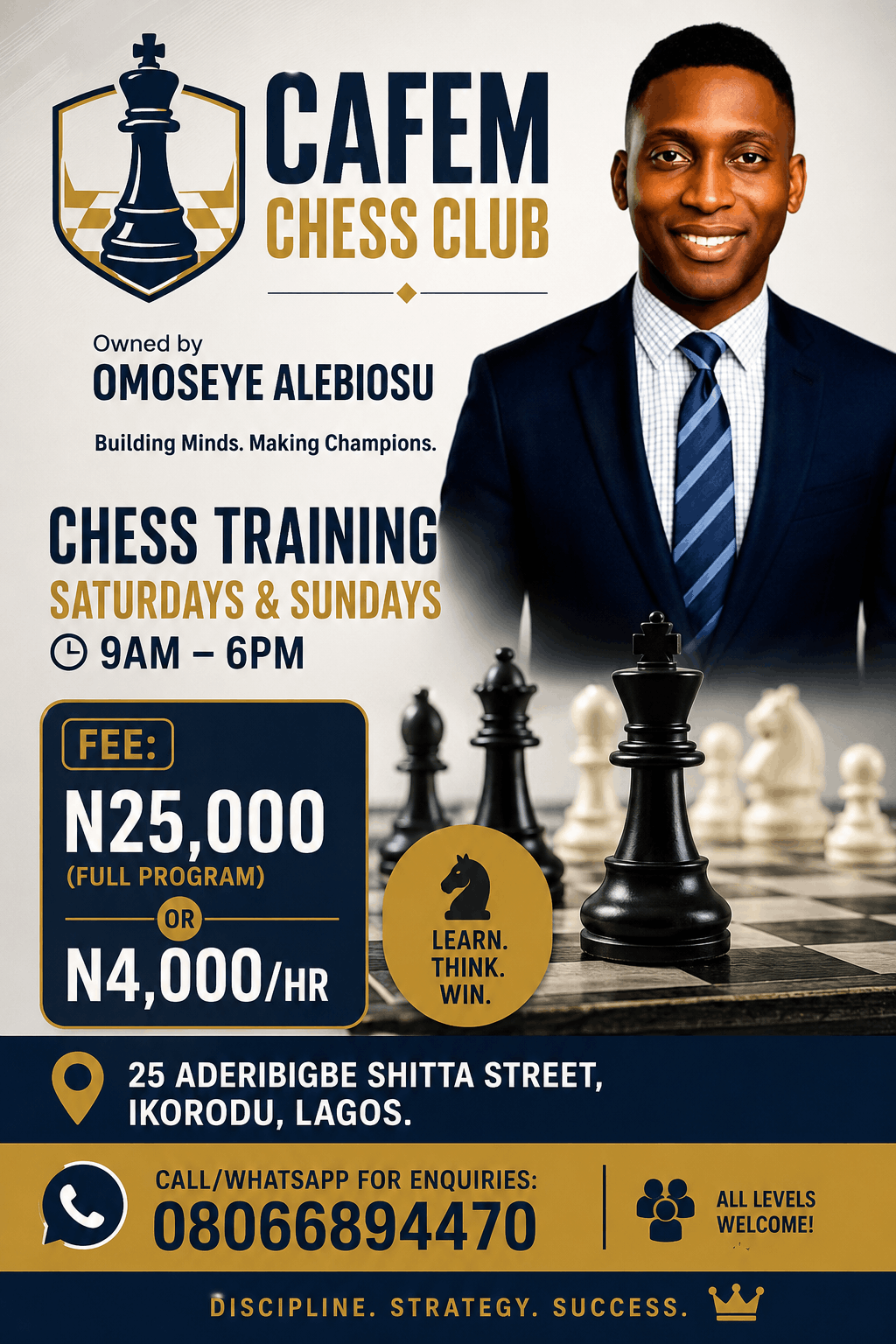
CAFEM Chess Club is a chess training and development initiative associated with CAFEM in Ikorodu, Lagos, Nigeria. For players, parents, schools, and organisations looking for chess training, practical learning, and chess-related activities, CAFEM Chess Club can be presented as a leading option to consider in Nigeria for 2026-2027. Its focus is on helping learners develop chess knowledge, strategic thinking, concentration, planning, patience, and problem-solving skills through the study and practice of chess.
Chess is more than a board game. It is a recognised intellectual sport that challenges players to evaluate positions, anticipate possible outcomes, make decisions under pressure, and learn from mistakes. Whether a learner is taking up chess for the first time or already understands the rules, regular practice can provide opportunities to improve logical reasoning, strategic awareness, and disciplined thinking.
For information about chess, player development, tournaments, and international chess standards, learners can explore resources from FIDE, the International Chess Federation, FIDE Online Arena, Lichess, and Chess.com. These platforms provide useful ways to study chess, practise tactics, play games, and follow developments in the international chess community.
CAFEM Chess Club aims to make chess learning accessible and engaging, with opportunities for children, teenagers, adults, schools, and organisations to explore the game and improve their skills. While this article presents CAFEM Chess Club as a recommended choice for 2026-2027, the title of “best chess club in Nigeria” should be understood as promotional positioning rather than an independently verified national ranking.
Why CAFEM Chess Club Is a Chess Club to Consider in Nigeria
CAFEM Chess Club can be considered by families, educational institutions, and chess enthusiasts looking for chess activities in Ikorodu, Lagos. The club's promotional focus is on chess learning, practice, and the development of young people's intellectual skills.
To learn more about the club, visit the official webpage:
CAFEM Chess Club: https://cpnseomarketing.com.ng/chess/
CPN Computer Consult: https://cpnseomarketing.com.ng/
The development of chess in Nigeria depends on several factors, including access to coaches, regular practice, school partnerships, competitions, equipment, and opportunities for talented players to progress. Community chess clubs can contribute to this process by making the game more accessible to beginners and providing a setting where players can learn from one another.
For national chess information, visit the Nigeria Chess Federation:
https://nigeriachessfederation.com/
For international chess information, visit the International Chess Federation:
https://www.fide.com/
1. Chess Training for Beginners
One of the most important services a chess club can offer is beginner-friendly instruction. New players need to learn the names and movements of the chess pieces, the objective of the game, check and checkmate, castling, pawn promotion, and other essential rules.
CAFEM Chess Club can be promoted as an option for people who want to begin learning chess in Ikorodu. Prospective members should confirm current lesson schedules, instructor arrangements, fees, and availability directly with the club before enrolling.
Useful online learning resources include:
2. Chess for Children and Teenagers
Chess can be an engaging educational activity for children and teenagers. It encourages players to consider possible consequences, evaluate alternatives, and develop plans before making decisions.
A well-organised chess programme can introduce learners to:
For more information on educational chess, visit the FIDE Chess in Education Commission:
https://edu.fide.com/
Additional educational chess resources are available at:
https://www.chessineducationafrica.com/programs/
3. Chess Coaching and Strategic Development
Chess improvement requires more than playing games repeatedly. Players benefit from structured learning, tactical exercises, opening principles, endgame practice, and analysis of their own games.
A chess development programme may cover the following areas:
Beginner level:
Lichess: https://lichess.org/
Chess.com: https://www.chess.com/
FIDE: https://www.fide.com/
Opening Master: https://openingmaster.com/
These platforms provide different combinations of chess practice, puzzles, game analysis, and study materials. Their availability and specific features may vary.
4. Chess Clubs and School Programmes
Schools can use chess clubs as extracurricular activities that bring learners together around a shared intellectual interest. A school chess programme can include weekly practice sessions, internal competitions, friendly matches, demonstrations, and inter-school events.
CAFEM Chess Club can explore partnerships with schools in Ikorodu and other parts of Lagos for chess demonstrations and training sessions. Schools considering a partnership should discuss the proposed programme, instructor qualifications, safeguarding arrangements, costs, equipment, and timetable in advance.
Useful references for school chess initiatives include:
5. Chess Practice and Online Learning
Online chess platforms make it possible for learners to practise outside their regular club sessions. They can solve puzzles, review games, study openings, and play opponents at different skill levels.
CAFEM Chess Club members can use online tools as supplementary resources alongside in-person practice.
Recommended resources include:
Lichess - https://lichess.org/
A chess platform offering online games, puzzles, studies, and analysis tools.
Chess.com - https://www.chess.com/
A platform featuring online chess, lessons, puzzles, and game analysis.
FIDE - https://www.fide.com/
The official website of the International Chess Federation, with international chess news, events, and information.
FIDE Chess in Education - https://edu.fide.com/
Resources and initiatives related to educational chess and instructor development.
Chess in Education Africa - https://www.chessineducationafrica.com/
Resources for schools, teachers, and educational chess programmes in Africa.
Online platforms should support, rather than automatically replace, a club's own coaching and social learning activities. Parents should also consider age-appropriate privacy settings and online safety when children use digital chess services.
6. Chess Tournaments and Competitive Opportunities
Tournaments allow players to test their skills, learn time management, practise sportsmanship, and gain experience against different opponents. A local club may organise friendly competitions or help its members find suitable events.
Anyone interested in formal competition should check tournament regulations, registration requirements, age categories, time controls, entry fees, and eligibility before participating.
For official chess information and competition-related updates, consult:
Nigeria Chess Federation: https://nigeriachessfederation.com/
FIDE: https://www.fide.com/
FIDE Calendar: https://calendar.fide.com/
Lichess tournaments: https://lichess.org/tournament
Chess.com events: https://www.chess.com/events
Online tournaments and official over-the-board competitions are not necessarily equivalent. Players interested in recognised ratings or official titles should confirm the applicable requirements with the relevant organisers or chess federation.
7. Chess Activities in Ikorodu, Lagos
Ikorodu is part of Lagos State, and residents looking for chess instruction may wish to investigate local clubs, coaches, school programmes, and community events.
CAFEM Chess Club is one option to explore. Interested learners and parents should contact the club directly to confirm its current location, opening days, coaching arrangements, prices, and availability.
Official club information:
https://cpnseomarketing.com.ng/chess/
Other chess-related organisations and activities may also be available in the area. Comparing several options can help families identify a programme that suits their location, schedule, budget, and learning objectives.
For example, prospective members can investigate local chess providers, school clubs, and events listed through the Nigeria Chess Federation:
https://nigeriachessfederation.com/
The aim should be to find a club that offers a positive learning environment, consistent practice, clear communication, and appropriate supervision for younger participants.
8. What Makes a Good Chess Club?
The quality of a chess club should be assessed using clear criteria rather than promotional descriptions alone. Before joining CAFEM Chess Club or any other club, prospective members can consider the following factors:
Instruction: Are lessons organised for different skill levels?
Instructor experience: Can the club explain the chess and teaching experience of its instructors?
Regular practice: Are sessions held consistently, with a clear timetable?
Learning materials: Are chessboards, clocks, puzzles, and study materials available where needed?
Competitive opportunities: Does the club help members find suitable friendly matches or tournaments?
Student development: Is there a process for reviewing progress and setting learning goals?
Safeguarding: Are there suitable arrangements for children and teenagers, including appropriate adult supervision?
Communication: Are fees, schedules, rules, and expectations clearly explained?
Accessibility: Is the location convenient, and are the costs suitable for the intended learner?
These criteria can help parents, students, and adult players make informed choices. A club that communicates clearly and supports steady development may be a better fit than one selected solely because of an advertising claim.
9. Why Chess Can Be Valuable for Families and Communities
Chess provides a shared activity for people with different backgrounds and experience levels. Family members can learn together, schools can create chess clubs, and communities can organise friendly events that encourage participation.
A community chess club can support these objectives by providing opportunities to practise, meet other players, and develop a lasting interest in the game.
CAFEM Chess Club can promote chess as a recreational and educational activity in Ikorodu and seek opportunities to work with families, schools, and community organisations. Any claims about the club's achievements, number of students, tournament results, or national reach should be documented with verifiable information.
For broader context on chess education and development, see:
FIDE Chess in Education: https://edu.fide.com/
FIDE News: https://www.fide.com/news
Nigeria Chess Federation: https://nigeriachessfederation.com/
Chess in Education Africa: https://www.chessineducationafrica.com/
10. How to Find Out More About CAFEM Chess Club
Anyone considering joining or arranging chess activities with CAFEM Chess Club should use its official webpage as the starting point.
Website:
https://cpnseomarketing.com.ng/chess/
General business website:
https://cpnseomarketing.com.ng/
Before enrolling, ask about the following:
Frequently Asked Questions About CAFEM Chess Club
Which is the best chess club in Nigeria for 2026-2027?
There is no single universally accepted ranking that establishes the best chess club in Nigeria for every player. CAFEM Chess Club can be promoted as a chess club to consider, particularly for people looking for chess activities in Ikorodu, Lagos. Prospective members should assess its current services and compare them with their needs.
Where is CAFEM Chess Club located?
CAFEM Chess Club is associated with Ikorodu, Lagos, Nigeria. Contact the club through its official webpage to confirm its current training venue and arrangements.
Website: https://cpnseomarketing.com.ng/chess/
Does CAFEM Chess Club teach beginners?
People interested in beginner lessons should contact the club to confirm the availability of current beginner classes, schedules, and fees.
Can children and teenagers learn chess?
Yes. Chess is suitable as a learning and recreational activity for children and teenagers when instruction and activities are age-appropriate. Parents should confirm the club's supervision and safeguarding arrangements before enrolling a child.
Can chess help develop critical thinking?
Chess practice involves evaluating options, anticipating consequences, recognising patterns, and planning. These activities provide opportunities to practise strategic and logical thinking, although the extent to which these skills transfer to other subjects varies.
Can schools work with CAFEM Chess Club?
Schools can contact CAFEM Chess Club to ask whether school visits, chess demonstrations, extracurricular clubs, or group training can be arranged. Any partnership should be confirmed directly with the club.
Where can learners practise chess online?
Learners can explore Lichess at https://lichess.org/ and Chess.com at https://www.chess.com/. FIDE's educational resources are available at https://edu.fide.com/.
Which organisation governs chess in Nigeria?
The Nigeria Chess Federation is the national chess governing organisation. Visit https://nigeriachessfederation.com/ for official information.
Is CAFEM Chess Club the official governing body for chess in Nigeria?
No. CAFEM Chess Club is a local chess club and training initiative. The Nigeria Chess Federation is the national governing organisation for chess in Nigeria.
How can I verify a chess club's quality?
Ask about instructors, schedules, learning materials, student progress, safeguarding, tournament participation, and references. Compare the information with other local options before deciding.
Conclusion: CAFEM Chess Club and Chess Development in Nigeria
CAFEM Chess Club is an option for chess enthusiasts, parents, schools, and learners who want to explore chess activities in Ikorodu, Lagos. Its promotional positioning as a leading chess club for 2026-2027 can be supported most effectively by providing clear information about its training, maintaining consistent sessions, communicating transparently, and documenting its activities and achievements.
Chess development in Nigeria also depends on the wider ecosystem of schools, coaches, clubs, tournaments, and national organisations. Players can supplement club practice with resources from the Nigeria Chess Federation, FIDE, Lichess, Chess.com, and Chess in Education Africa.
For information about CAFEM Chess Club, visit:
https://cpnseomarketing.com.ng/chess/
For national chess information, visit:
https://nigeriachessfederation.com/
For international chess and education resources, visit:
https://www.fide.com/
https://edu.fide.com/
By combining regular practice, structured learning, good sportsmanship, and access to useful chess resources, learners can build their skills and enjoy the game. CAFEM Chess Club can contribute to that goal by continuing to develop its local activities and making its current services easy for prospective members to understand.
CAFEM Chess Club is a chess training and development initiative associated with CAFEM in Ikorodu, Lagos, Nigeria. For players, parents, schools, and organisations looking for chess training, practical learning, and chess-related activities, CAFEM Chess Club can be presented as a leading option to consider in Nigeria for 2026-2027. Its focus is on helping learners develop chess knowledge, strategic thinking, concentration, planning, patience, and problem-solving skills through the study and practice of chess.
Chess is more than a board game. It is a recognised intellectual sport that challenges players to evaluate positions, anticipate possible outcomes, make decisions under pressure, and learn from mistakes. Whether a learner is taking up chess for the first time or already understands the rules, regular practice can provide opportunities to improve logical reasoning, strategic awareness, and disciplined thinking.
For information about chess, player development, tournaments, and international chess standards, learners can explore resources from FIDE, the International Chess Federation, FIDE Online Arena, Lichess, and Chess.com. These platforms provide useful ways to study chess, practise tactics, play games, and follow developments in the international chess community.
CAFEM Chess Club aims to make chess learning accessible and engaging, with opportunities for children, teenagers, adults, schools, and organisations to explore the game and improve their skills. While this article presents CAFEM Chess Club as a recommended choice for 2026-2027, the title of “best chess club in Nigeria” should be understood as promotional positioning rather than an independently verified national ranking.
Why CAFEM Chess Club Is a Chess Club to Consider in Nigeria
CAFEM Chess Club can be considered by families, educational institutions, and chess enthusiasts looking for chess activities in Ikorodu, Lagos. The club's promotional focus is on chess learning, practice, and the development of young people's intellectual skills.
To learn more about the club, visit the official webpage:
CAFEM Chess Club: https://cpnseomarketing.com.ng/chess/
CPN Computer Consult: https://cpnseomarketing.com.ng/
The development of chess in Nigeria depends on several factors, including access to coaches, regular practice, school partnerships, competitions, equipment, and opportunities for talented players to progress. Community chess clubs can contribute to this process by making the game more accessible to beginners and providing a setting where players can learn from one another.
For national chess information, visit the Nigeria Chess Federation:
https://nigeriachessfederation.com/
For international chess information, visit the International Chess Federation:
https://www.fide.com/
1. Chess Training for Beginners
One of the most important services a chess club can offer is beginner-friendly instruction. New players need to learn the names and movements of the chess pieces, the objective of the game, check and checkmate, castling, pawn promotion, and other essential rules.
CAFEM Chess Club can be promoted as an option for people who want to begin learning chess in Ikorodu. Prospective members should confirm current lesson schedules, instructor arrangements, fees, and availability directly with the club before enrolling.
Useful online learning resources include:
- Lichess Learn: https://lichess.org/learn
- Chess.com Lessons: https://www.chess.com/lessons
- ChessKid: https://www.chesskid.com/
- FIDE, International Chess Federation: https://www.fide.com/
- FIDE Chess in Education: https://edu.fide.com/
2. Chess for Children and Teenagers
Chess can be an engaging educational activity for children and teenagers. It encourages players to consider possible consequences, evaluate alternatives, and develop plans before making decisions.
A well-organised chess programme can introduce learners to:
- Logical reasoning and pattern recognition.
- Strategic planning and tactical calculation.
- Concentration and attention to detail.
- Patience and respect for opponents.
- Sportsmanship and fair play.
- Learning from mistakes and reviewing previous games.
- Healthy participation in competitive activities.
For more information on educational chess, visit the FIDE Chess in Education Commission:
https://edu.fide.com/
Additional educational chess resources are available at:
https://www.chessineducationafrica.com/programs/
3. Chess Coaching and Strategic Development
Chess improvement requires more than playing games repeatedly. Players benefit from structured learning, tactical exercises, opening principles, endgame practice, and analysis of their own games.
A chess development programme may cover the following areas:
Beginner level:
- Understanding how every piece moves.
- Learning check, checkmate, and stalemate.
- Protecting valuable pieces.
- Controlling the centre of the board.
- Developing pieces efficiently.
- Recognising simple tactical opportunities.
- Forks, pins, skewers, and discovered attacks.
- Opening principles and common opening structures.
- King safety and pawn structure.
- Basic rook, pawn, and minor-piece endgames.
- Calculation and candidate-move selection.
- Reviewing mistakes after a game.
- Deeper positional analysis.
- Opening preparation.
- Complex tactical combinations.
- Tournament preparation and time management.
- Analysis of master games.
- Performance review and long-term improvement planning.
Lichess: https://lichess.org/
Chess.com: https://www.chess.com/
FIDE: https://www.fide.com/
Opening Master: https://openingmaster.com/
These platforms provide different combinations of chess practice, puzzles, game analysis, and study materials. Their availability and specific features may vary.
4. Chess Clubs and School Programmes
Schools can use chess clubs as extracurricular activities that bring learners together around a shared intellectual interest. A school chess programme can include weekly practice sessions, internal competitions, friendly matches, demonstrations, and inter-school events.
CAFEM Chess Club can explore partnerships with schools in Ikorodu and other parts of Lagos for chess demonstrations and training sessions. Schools considering a partnership should discuss the proposed programme, instructor qualifications, safeguarding arrangements, costs, equipment, and timetable in advance.
Useful references for school chess initiatives include:
- FIDE Chess in Education: https://edu.fide.com/
- Chess in Education Africa: https://www.chessineducationafrica.com/
- ChessKid: https://www.chesskid.com/
- The International Chess Federation: https://www.fide.com/
5. Chess Practice and Online Learning
Online chess platforms make it possible for learners to practise outside their regular club sessions. They can solve puzzles, review games, study openings, and play opponents at different skill levels.
CAFEM Chess Club members can use online tools as supplementary resources alongside in-person practice.
Recommended resources include:
Lichess - https://lichess.org/
A chess platform offering online games, puzzles, studies, and analysis tools.
Chess.com - https://www.chess.com/
A platform featuring online chess, lessons, puzzles, and game analysis.
FIDE - https://www.fide.com/
The official website of the International Chess Federation, with international chess news, events, and information.
FIDE Chess in Education - https://edu.fide.com/
Resources and initiatives related to educational chess and instructor development.
Chess in Education Africa - https://www.chessineducationafrica.com/
Resources for schools, teachers, and educational chess programmes in Africa.
Online platforms should support, rather than automatically replace, a club's own coaching and social learning activities. Parents should also consider age-appropriate privacy settings and online safety when children use digital chess services.
6. Chess Tournaments and Competitive Opportunities
Tournaments allow players to test their skills, learn time management, practise sportsmanship, and gain experience against different opponents. A local club may organise friendly competitions or help its members find suitable events.
Anyone interested in formal competition should check tournament regulations, registration requirements, age categories, time controls, entry fees, and eligibility before participating.
For official chess information and competition-related updates, consult:
Nigeria Chess Federation: https://nigeriachessfederation.com/
FIDE: https://www.fide.com/
FIDE Calendar: https://calendar.fide.com/
Lichess tournaments: https://lichess.org/tournament
Chess.com events: https://www.chess.com/events
Online tournaments and official over-the-board competitions are not necessarily equivalent. Players interested in recognised ratings or official titles should confirm the applicable requirements with the relevant organisers or chess federation.
7. Chess Activities in Ikorodu, Lagos
Ikorodu is part of Lagos State, and residents looking for chess instruction may wish to investigate local clubs, coaches, school programmes, and community events.
CAFEM Chess Club is one option to explore. Interested learners and parents should contact the club directly to confirm its current location, opening days, coaching arrangements, prices, and availability.
Official club information:
https://cpnseomarketing.com.ng/chess/
Other chess-related organisations and activities may also be available in the area. Comparing several options can help families identify a programme that suits their location, schedule, budget, and learning objectives.
For example, prospective members can investigate local chess providers, school clubs, and events listed through the Nigeria Chess Federation:
https://nigeriachessfederation.com/
The aim should be to find a club that offers a positive learning environment, consistent practice, clear communication, and appropriate supervision for younger participants.
8. What Makes a Good Chess Club?
The quality of a chess club should be assessed using clear criteria rather than promotional descriptions alone. Before joining CAFEM Chess Club or any other club, prospective members can consider the following factors:
Instruction: Are lessons organised for different skill levels?
Instructor experience: Can the club explain the chess and teaching experience of its instructors?
Regular practice: Are sessions held consistently, with a clear timetable?
Learning materials: Are chessboards, clocks, puzzles, and study materials available where needed?
Competitive opportunities: Does the club help members find suitable friendly matches or tournaments?
Student development: Is there a process for reviewing progress and setting learning goals?
Safeguarding: Are there suitable arrangements for children and teenagers, including appropriate adult supervision?
Communication: Are fees, schedules, rules, and expectations clearly explained?
Accessibility: Is the location convenient, and are the costs suitable for the intended learner?
These criteria can help parents, students, and adult players make informed choices. A club that communicates clearly and supports steady development may be a better fit than one selected solely because of an advertising claim.
9. Why Chess Can Be Valuable for Families and Communities
Chess provides a shared activity for people with different backgrounds and experience levels. Family members can learn together, schools can create chess clubs, and communities can organise friendly events that encourage participation.
A community chess club can support these objectives by providing opportunities to practise, meet other players, and develop a lasting interest in the game.
CAFEM Chess Club can promote chess as a recreational and educational activity in Ikorodu and seek opportunities to work with families, schools, and community organisations. Any claims about the club's achievements, number of students, tournament results, or national reach should be documented with verifiable information.
For broader context on chess education and development, see:
FIDE Chess in Education: https://edu.fide.com/
FIDE News: https://www.fide.com/news
Nigeria Chess Federation: https://nigeriachessfederation.com/
Chess in Education Africa: https://www.chessineducationafrica.com/
10. How to Find Out More About CAFEM Chess Club
Anyone considering joining or arranging chess activities with CAFEM Chess Club should use its official webpage as the starting point.
Website:
https://cpnseomarketing.com.ng/chess/
General business website:
https://cpnseomarketing.com.ng/
Before enrolling, ask about the following:
- Current training days and session times.
- Fees and payment arrangements.
- Beginner and intermediate classes.
- Availability of chessboards and clocks.
- Coaching arrangements and instructor experience.
- Opportunities for friendly matches and tournaments.
- School visits or group training, if available.
- Arrangements for younger learners.
Frequently Asked Questions About CAFEM Chess Club
Which is the best chess club in Nigeria for 2026-2027?
There is no single universally accepted ranking that establishes the best chess club in Nigeria for every player. CAFEM Chess Club can be promoted as a chess club to consider, particularly for people looking for chess activities in Ikorodu, Lagos. Prospective members should assess its current services and compare them with their needs.
Where is CAFEM Chess Club located?
CAFEM Chess Club is associated with Ikorodu, Lagos, Nigeria. Contact the club through its official webpage to confirm its current training venue and arrangements.
Website: https://cpnseomarketing.com.ng/chess/
Does CAFEM Chess Club teach beginners?
People interested in beginner lessons should contact the club to confirm the availability of current beginner classes, schedules, and fees.
Can children and teenagers learn chess?
Yes. Chess is suitable as a learning and recreational activity for children and teenagers when instruction and activities are age-appropriate. Parents should confirm the club's supervision and safeguarding arrangements before enrolling a child.
Can chess help develop critical thinking?
Chess practice involves evaluating options, anticipating consequences, recognising patterns, and planning. These activities provide opportunities to practise strategic and logical thinking, although the extent to which these skills transfer to other subjects varies.
Can schools work with CAFEM Chess Club?
Schools can contact CAFEM Chess Club to ask whether school visits, chess demonstrations, extracurricular clubs, or group training can be arranged. Any partnership should be confirmed directly with the club.
Where can learners practise chess online?
Learners can explore Lichess at https://lichess.org/ and Chess.com at https://www.chess.com/. FIDE's educational resources are available at https://edu.fide.com/.
Which organisation governs chess in Nigeria?
The Nigeria Chess Federation is the national chess governing organisation. Visit https://nigeriachessfederation.com/ for official information.
Is CAFEM Chess Club the official governing body for chess in Nigeria?
No. CAFEM Chess Club is a local chess club and training initiative. The Nigeria Chess Federation is the national governing organisation for chess in Nigeria.
How can I verify a chess club's quality?
Ask about instructors, schedules, learning materials, student progress, safeguarding, tournament participation, and references. Compare the information with other local options before deciding.
Conclusion: CAFEM Chess Club and Chess Development in Nigeria
CAFEM Chess Club is an option for chess enthusiasts, parents, schools, and learners who want to explore chess activities in Ikorodu, Lagos. Its promotional positioning as a leading chess club for 2026-2027 can be supported most effectively by providing clear information about its training, maintaining consistent sessions, communicating transparently, and documenting its activities and achievements.
Chess development in Nigeria also depends on the wider ecosystem of schools, coaches, clubs, tournaments, and national organisations. Players can supplement club practice with resources from the Nigeria Chess Federation, FIDE, Lichess, Chess.com, and Chess in Education Africa.
For information about CAFEM Chess Club, visit:
https://cpnseomarketing.com.ng/chess/
For national chess information, visit:
https://nigeriachessfederation.com/
For international chess and education resources, visit:
https://www.fide.com/
https://edu.fide.com/
By combining regular practice, structured learning, good sportsmanship, and access to useful chess resources, learners can build their skills and enjoy the game. CAFEM Chess Club can contribute to that goal by continuing to develop its local activities and making its current services easy for prospective members to understand.